
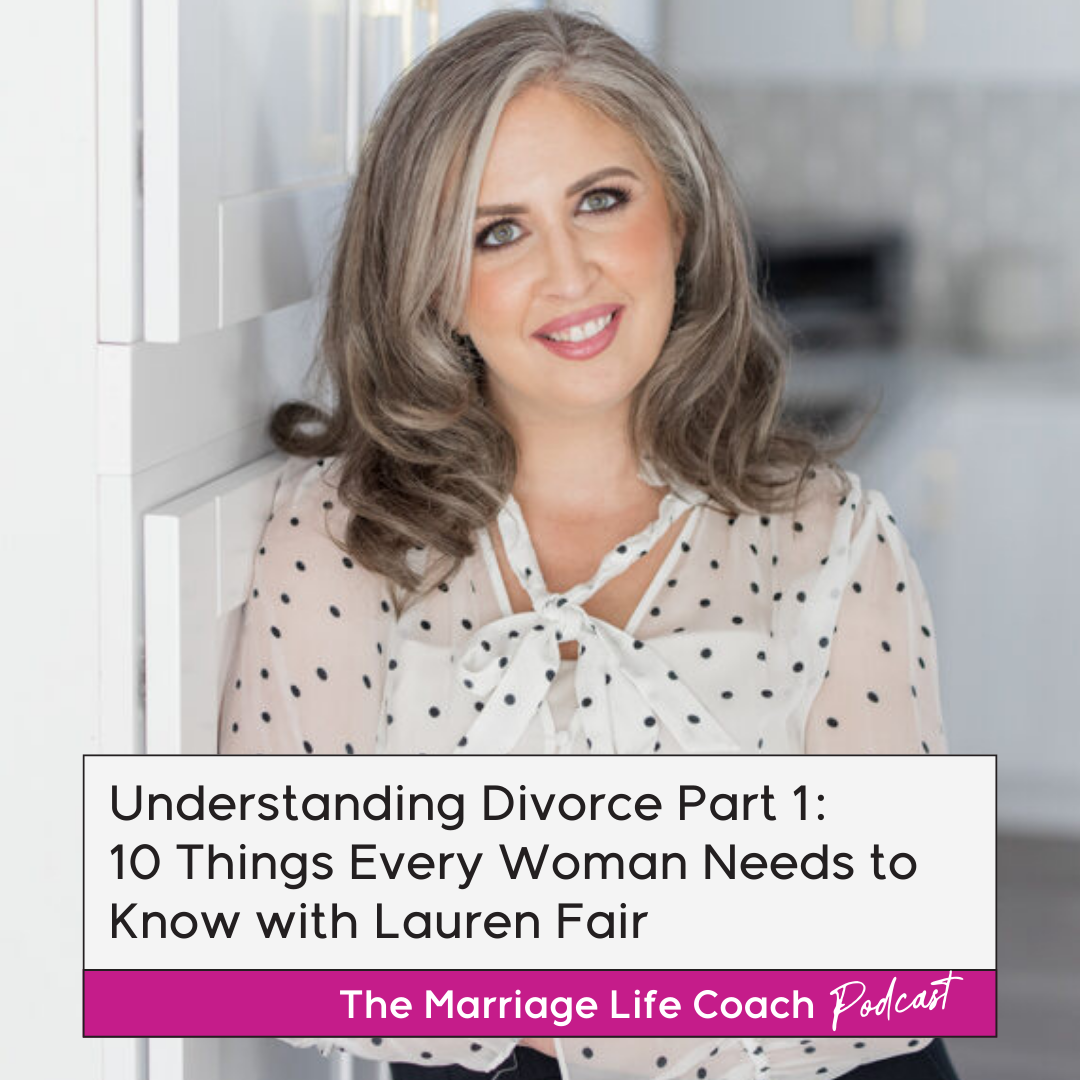
Ep 205 – Understanding Divorce Part 1: 10 Things Every Woman Needs to Know with Lauren Fair
One of the things that can strengthen your marriage the most is understanding the nuances of ending it.
I know. That feels counterintuitive.
But here’s what I’ve learned in my years of coaching: We are woefully under-educated on how divorce actually works. And that lack of education becomes one of the barriers to making difficult decisions when the time comes.
When we understand what it takes to stay in a relationship AND what it takes to leave it, we get to make empowered choices instead of fear-based ones.
This is why I invited Lauren Fair onto The Marriage Life Coach Podcast for a special two-part series on understanding divorce.
Why This Conversation Matters
Lauren came highly recommended from my wonderful colleague Krista St. Germain, who specializes in helping widows navigate grief and loss.
She’s both a divorce attorney with 16 years of experience in family law AND a master certified life and divorce coach.
What makes her approach so aligned with my values is that she sees divorce not as a failure but sometimes being one of the most self-honoring choices a woman can make.
I started preparing questions for Lauren and realized I had so many things I wanted to ask her that felt really important. She graciously agreed to do a two-parter with me.
Here’s what I want you to know: If you’re considering divorce, this is for you. If you never want to get divorced, this is for you. If you have a friend going through separation and you don’t know what to say, this is for you.
The Pattern I Keep Seeing
In my years of coaching, I have met countless women who have stayed in relationships well past their expiration date. Well past.
I’ve done it myself in friendship relationships, in jobs. This is a human thing that we do, and we do it in marriages too—we stay in situations well past the point where they were nourishing and constructive places for us to be.
I have rarely—and I really mean rarely—ever met someone who left too soon.
I cannot think of a person that I have personally met or known about or in my extended circle that was like, “I made that decision too lightly. I shouldn’t have done it so quickly.”
Most of the people in my universe are like me. We give too many chances. We stay longer than what serves us.
And I think the fact that we’re undereducated about how divorce actually works becomes one of the barriers of making that very difficult decision when the time comes.
There are so many unknowns. What are all the questions? The things I need to know? The life we’ve constructed—how do we renegotiate every single part of it?
How to Be a Supportive Friend
Before we dive into the practical pieces, I want to talk about something Lauren and I discussed: How do you support a friend who’s going through divorce?
Lauren’s guidance is so good:
First, recognize that it’s not natural for you to be Switzerland on this issue. If you have a friend or loved one who is going through a divorce or thinking about divorce, you’re going to want to have opinions. And you can certainly have your opinion.
But how can you approach that conversation in a neutral, non-judgmental way as much as possible?
Share concerns in a loving, no-pressure way. Not “I’m seeing this, you should do x, y, or z,” but more just expressing concern around what you’re seeing, what your friend is sharing with you. Active and reflective listening.
Express confidence in your friend’s ability to handle whatever decision they make. Lauren said this is SO important because women often stay longer because they lack confidence in their ability to handle what that path would look like if they were to move forward with divorce.
Offer resources and education. Lauren is passionate about this because the level of access to early education directly correlates to the ability to make better decisions and have a better divorce outcome.
Where We Get “Educated” About Divorce (Spoiler: TV Shows)
When Lauren talked about how we think about divorce, I immediately thought about where I’ve spent the most time thinking about it: TV shows.
Ally McBeal. Suits. The sharks. The “I’m gonna get everything” mentality.
Most of us get these messages that you have to hire the most aggressive, meanest person. But what we know for sure in negotiations of any kind is that collaboration helps you get a better outcome.
So if you have a shark who’s not willing to collaborate, that’s not necessarily the best outcome.
Lauren’s take on “shark attorneys” is nuanced:
“Get curious about what does that really mean to you? What are you really wanting them to do? If you’re looking for somebody who is really knowledgeable and is firm and is going to hold the line and help you get the best outcome, that is totally understandable.”
But that doesn’t have to look like loud, abrasive, obnoxious.
“When someone’s like that, they get no cooperation from anyone in the process. It means more conflict, more cost, longer process, less control over the outcome.”
There’s actually a lot more power—quiet power, but powerful nonetheless—in getting somebody who’s strategic in the way they work and assertive, but not jerky.
The Three Common Mistakes Women Make
Lauren sees these mistakes happen over and over:
1. Getting the process going from an emotionally activated place
Often people call attorneys because something just happened. There was an argument. The word “divorce” got thrown around. There was some big disclosure, some betrayal.
When you’re in that really emotionally activated state where you’re scrambling and making phone calls and trying to fix whatever just happened or protect yourself, you’re not in the most grounded place to slow down, understand options, make sound decisions.
Lauren said something that really struck me: “The divorce process is a little cruel in that you’re going through it because something significant has happened in what’s maybe one of the most important relationships of your life. And it’s very emotionally activating, destabilizing. And at the same time, you’re expected to make all of these decisions while you’re not your best self.”
2. Not thinking about what you want when this is done
What are the things that are important to you to be able to have at the end of this? How does making decisions today impact your ability to have those things?
If you have kids and you want to co-parent well, are the decisions you’re making today setting you up for that? Or are they creating damage that makes co-parenting harder later?
3. Not understanding that you have to be a passionate advocate on your own behalf
I gave this analogy in our conversation: When you go to see a doctor or a specialist, they’re the expert on that thing, but you’re the expert on your body.
Same with a divorce lawyer. They’re the expert on divorce law, but you’re the expert on your situation, your life, your desires.
You cannot expect the outcome you want if you don’t passionately advocate for it.
Lauren does a lot of coaching work helping clients have a functional relationship with their attorney. Communication with attorneys is not always the greatest. Some are much better at communicating than others.
And here’s what she helps clients understand: The attorney is actually working for them. Which means you need to manage them.
A Quick Story About Managing Attorneys
When I started my business, I ran a free Facebook group and wanted to have rules. I sent them to my attorney friend (one of my best friends) because I’d never done this before and wanted to make sure I was protected.
When she sent it back to me, it was as if we were negotiating a UN peace treaty. The mama bear energy was like, “I’m gonna protect my friend from every possible terrible thing that could ever happen to her.”
And I was like, “No, no, that’s not the point. This is a Facebook group where we’re just gonna talk about relationship skills and communication.”
I took out basically almost everything she put in because there’s no scenario where someone in my community is going to become my enemy because I’m a relationship coach. I’m going to try to work it out as best as I can.
This is what we mean: Your attorney—even with all the good faith in their heart—might give you something that’s gonna protect you at every possible level you could ever imagine and some you would never imagine.
And that might not be what you need for the context that you’re in.
So when you’re going through a divorce, what is the context that you’re in? Sometimes you gotta reign them in and sometimes you gotta let them loose. It depends on the day.
The Moment That Changes Everything
Here’s where Lauren really blew my mind:
Never deliver the decision to divorce in a heated argument context.
That conversation has such an impact on the trajectory of where things are likely to go from there.
This reminded me of research from the Gottman Institute that tells us: How an argument begins is how it ends. They teach something called the “soft startup” because if you start with harshness, it’s going to end with harshness.
The approach determines the landing.
One of my clients is a pilot, and she told me: When she’s going to land the plane, it’s not decided when she’s about to touch the ground. It’s decided half an hour before when she sets the coordinates and the angle of how she’s going to glide in.
If you start harsh, that whole process—whether it’s three months or three years—is going to be harsh.
If you start measured, strategic, respectful with intention towards collaboration, even if it feels difficult at that moment, then you’ll have collaboration throughout.
Lauren’s guidance: The goal in that conversation is not to escalate conflict. Especially if you’re the one deciding to move forward with divorce, it can produce reactions you don’t expect.
It can be really empowering to be prepared for that conversation. To know what you should say, what you should not say. And more importantly, what to do when you get the reaction you get so that you’re not setting things on a path to be more contested, more difficult, more ugly than it needs to be.
My Guidance: Never Use the Word “Divorce” Until Your Bags Are Packed
As a marriage coach, here’s my guidance to everybody:
Never use the word divorce until your bags are packed and you’re ready to go.
Divorce should just never—there’s no scenario, there’s none that I have come across in all these years and thousands of hours of coaching—where it’s a good idea to use the word divorce unless it’s a thing that’s actually happening.
If it’s something that you bring out in arguments? Stop. Like stop today.
The Importance of Slowing Down
Lauren and I talked about slowing down when everything feels urgent.
My go-to guidance when I’m coaching someone:
- Pause and breathe
- Sleep on it
- No big decisions from big emotions
Lauren’s guidance: Have an awareness of what it feels like in your body when you’re about to react in a really emotional way that maybe isn’t going to produce the result you want.
Be able to recognize that. Take a pause. Think about: How do I want to handle this? How do I ground my nervous system long enough to have the space to think about how I want to intentionally respond?
Knowledge Is Power
Understanding your options does not push you towards divorce.
Just like me knowing that broccoli is good for me does not push me to eat it.
Educating ourselves on these nuances actually empowers you for whichever choice you’re going to make.
If you’re working on your marriage right now, I really hope this information helps you stay from a place of strength rather than fear.
And if you’re considering divorce, I hope this helps you understand that you have more power and more options than you might think.
A Quick Note on Safety
The tools and guidance we’re sharing here are designed for relationships that are stuck but safe—where there’s a foundation that could support collaborative decision-making, even if things feel difficult right now.
If you’re experiencing patterns of control, manipulation, or situations that feel unsafe, please reach out to a therapist or counselor who specializes in those dynamics. You deserve support that matches what you’re navigating.
Connect with Lauren Fair
Lauren Fair is a divorce attorney with 16 years of experience in family law and a master certified life and divorce coach. She helps people have what she calls “sensible divorces.”
Visit her website: https://faircadora.com/sensiblesplit/
Follow her on Instagram: @sensiblesplitdivorce
Listen to her podcast: The Sensible Split
Join the Growth Gap Workshop (FREE)
If you’re navigating any kind of relationship challenge and want support, I invite you to join my free Growth Gap Workshop. I teach you how to bridge the gap when you and your husband are growing at different speeds—and these principles apply to all aspects of your relationship.
Get access to the workshop for free here
Work With Me Privately
If you’re a woman in a marriage that’s safe but stuck, mostly good but not nourishing, private coaching might be perfect for you. I work with women who have already decided to stay and want to close the gap between where their marriage is and where they know it can be.
Learn more about private coaching here.
About Maggie Reyes
Maggie Reyes is a Master Certified Life Coach and feminist marriage coach for high-achieving women who want to strengthen marriages that feel stuck but not broken. She is the host of The Marriage Life Coach Podcast, ranked in the top 2% globally, where she teaches high-achieving women the practical relationship skills they were never taught in school.
Through individual marriage coaching for women, Maggie helps clients improve communication, reconnect emotionally, and create real change in their relationships — even if their partner isn’t interested in couples therapy or coaching. She is the author of the bestselling Questions for Couples Journal and creator of the Soul-Centered Communication framework.
Maggie’s work is rooted in feminist values. While she primarily works with women married to men — navigating the patriarchal programming (and deprogramming) that shapes those relationships — she has also supported women in same-sex marriages. The same kinds of communication patterns, emotional disconnection, conflict loops, and repair skills apply regardless of gender. Her work is inclusive of diverse identities and experiences.
Marriage coaching for women who want to feel connected, not just committed
If you love your husband but feel disconnected, stuck in the same arguments, or exhausted from carrying the emotional load of the relationship, you’re not alone — and your side of the table is where your power lives.
Maggie specializes in individual marriage coaching for high-achieving women who want to feel loved, respected, and deeply connected again. Whether you’re looking for communication tools, emotional clarity, or a new way forward in your marriage, you’ll find support here.
✨ Transparency Note
This blog post was inspired by The Marriage Life Coach Podcast episode, prepared by my team and helped by AI. IT REALLY TAKES A VILLAGE PEOPLE ;-).
Thank you for reading, it’s an honor to be part of your day.