
Ep 201 – Friend Breakups and Conscious Uncoupling: How to End Relationships with Love
It’s 1 a.m. and I’m sitting with my little notebook. The one with flowers on the front that says “life is beautiful.”
I’m feeling really unsettled. Really dysregulated, which is what life coaches and therapists call it when your nervous system is activated. I’m feeling shaky.
I’m going through a friend breakup right now. Someone who was in my innermost circle for many years. And something had happened that triggered a lot of anger about how things were going down.
So I did what any modern person does at 1 a.m. when they’re struggling: I Googled.
I’d heard about this conscious uncoupling thing. I knew it was created for romantic relationships, but I thought: what if I applied these steps to this friendship breakup?
I found the framework, started journaling furiously through the prompts, and by the end of the session, I felt so much better that I knew I needed to have this conversation on the podcast.
But here’s where the story gets good.
I went out searching for someone certified in conscious uncoupling who I could interview. And unbeknownst to me, a few years ago I had done an advanced certification in feminist coaching, which has deeply influenced everything I talk about and everything I do. And one of my fellow alumni, one of my colleagues who also did that amazing process, is also certified in conscious uncoupling.
I cannot tell you the level of excitement I had when I realized this. It felt like the universe conspiring to help me exactly when I needed it most.
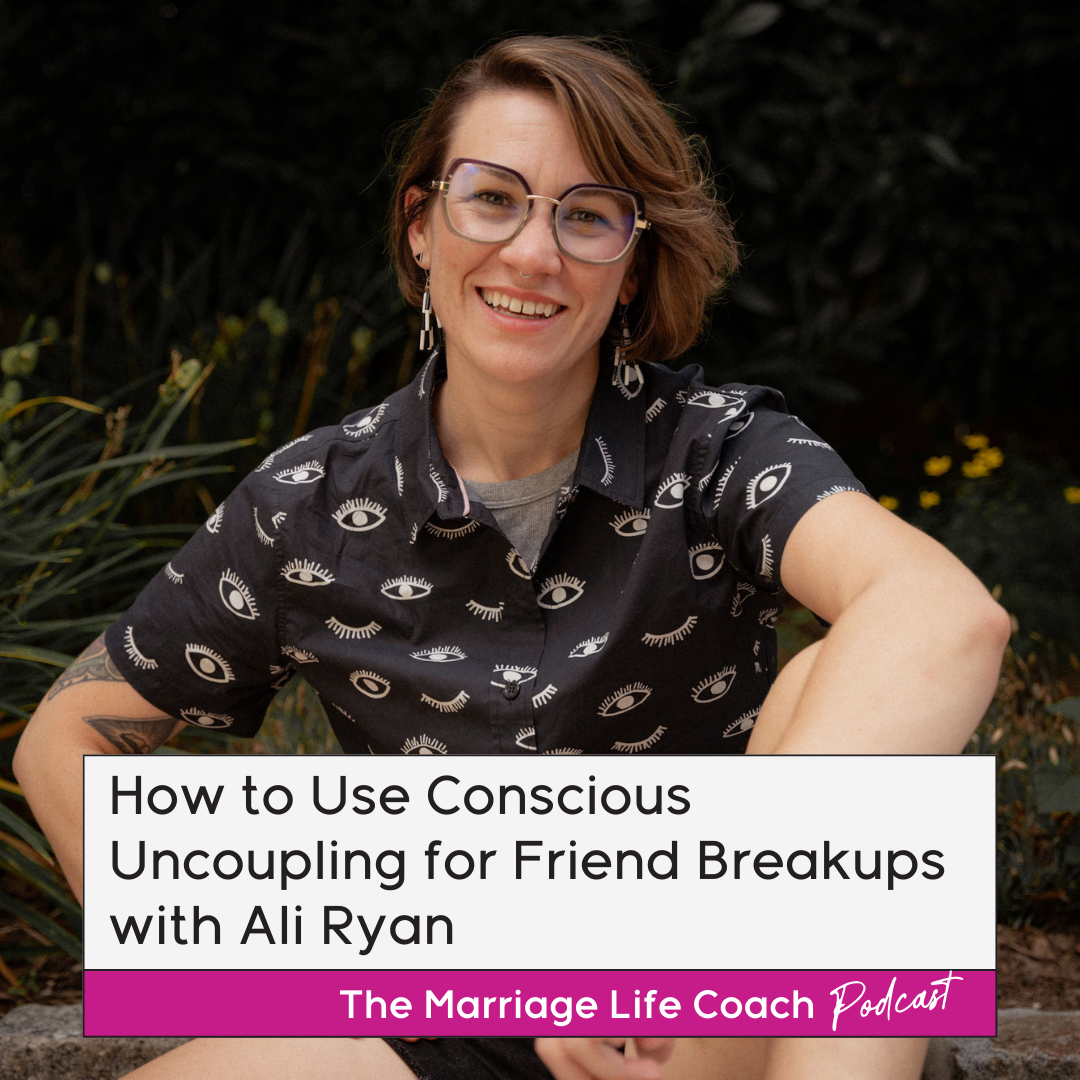
That’s how Ali Ryan ended up on this episode. And I’m so grateful she did.
The Problem: We Don’t Talk About Friend Breakups
Here’s what I’ve realized: we have entire industries built around romantic breakups. Songs, movies, therapists, coaches, books, podcasts dedicated to navigating the end of romantic relationships.
But when a friendship ends? We’re often left navigating it alone.
We don’t have the same cultural scripts for friend breakups that we have for romantic ones. We don’t know how to talk about them. We feel guilty for needing space from someone we once loved. We make ourselves wrong for changing. Or we make the other person wrong for not changing with us.
In my conversation with Ali, she said something that really stuck with me. We live in a society where we’re largely unconscious, both in the coupling and in the uncoupling.
And it’s true. Just turn on the radio and listen to the songs. Almost every song is an example of some kind of dysfunctional romantic relationship and the fallout thereof.
We all know what it’s like to fall in love, to have that spark, that new relationship energy. And we also all know what it’s like to be heartbroken, to feel betrayal, to wonder who we are without this person.
But we rarely talk about how to end relationships consciously. With intention. With love.
What Is Conscious Uncoupling?
Let’s get away from the buzzword for a moment.
Yes, there were famous people doing it, Gywneth Paltrow used it very famously in her divorce.
But let’s talk about what it actually means for real humans doing real hard work in real relationships.
Ali describes conscious uncoupling as knowing that something needs to end, having awareness that it’s not working as it is and needs to evolve. But here’s the key: how can it evolve in a way where it’s not devastation?
She explains: “How can we not fall into our survival brain’s need to make something right or wrong, where we’re actually loving ourselves even more through the process and really shifting the paradigm of what relationships can be when we realize that there’s chapters that need to evolve and that we don’t have to make someone right or wrong, good or bad in that process?”
The conscious uncoupling framework was created by Katherine Woodward Thomas, a marriage and family therapist and New York Times bestselling author. She developed this process and certifies coaches in it.
And while it was originally designed for romantic relationships, the principles apply beautifully to friendships.
Ali’s Journey to This Work
Ali came to this work through her own experience. She went through a divorce in 2017, her second one. But this time, she was committed to not having the kind of heartbreak she’d had the first time.
There were more kids involved. There was deep love with the person she was married to. And also, it wasn’t working.
She shares: “We went through this process. We really maintained love and integrity for ourselves and for each other. We stayed in the goal of what we wanted, which is we want to stay friends and raise our kids in peace and really make it about still having family and being a family.”
At the time, she didn’t even know anyone else who maintained a friendship or close co-parenting relationship after divorce. Years later, when she heard a podcast about conscious uncoupling, she realized: “Wait, that sounds so familiar of what I have done.”
She recognized that the way we’re conditioned around breakups makes them so much harder and uglier than they need to be. And she wanted to offer people a different way.
Why Conscious Uncoupling Matters
Ali said something in our conversation that really struck me: “The reality is we either break up or someone passes away. Everything ends. Most relationships do end. How can we, in a society that is obsessed with love, cause we really are, we love to love, also have that freedom and that option of sometimes I can love you and also know that I don’t want this in this way anymore?”
That’s the heart of it. We need to be able to hold both.
We need to be able to say: I loved you. I still care about you. And also, this relationship needs to change or end.
Without making anyone wrong. Without falling into our survival brain’s need to create a villain and a victim.
The Five Steps of Conscious Uncoupling
The conscious uncoupling framework has five steps. While Ali and I didn’t go through each step in detail on the podcast (that would be its own workshop!), we talked about the overall approach.
The process involves:
Step 1: Finding emotional freedom from your ex (or in this case, from the friend you’re separating from)
Step 2: Reclaiming your power and your life
Step 3: Breaking patterns that keep you stuck
Step 4: Becoming a love alchemist (transforming the pain into wisdom)
Step 5: Creating your happy life
What I love about this framework is that it’s not about vilifying the other person. It’s not about making them wrong so you can be right. It’s about taking responsibility for your own healing, your own growth, and your own next chapter.
How I Applied This to My Friend Breakup
When I was journaling at 1 a.m., I went through these steps with my friendship in mind. I asked myself:
What emotional freedom do I need to find? What am I still holding onto that’s keeping me stuck?
Where have I given my power away in this relationship? Where do I need to reclaim it?
What patterns have I been repeating? What do I want to do differently going forward?
How can I transform this pain into wisdom? What am I learning about myself through this?
What does my happy life look like on the other side of this?
These questions helped me get out of my activated nervous system state and into a more grounded place. They helped me stop making my friend wrong and start focusing on what I needed to do for myself.
The Importance of Staying Out of Survival Brain
One thing Ali emphasized is the importance of not falling into survival brain when a relationship ends.
Survival brain wants to make someone right or wrong. It wants to create a clear villain and victim. It wants to fight, flee, or freeze.
But when we can stay regulated, when we can stay in what Ali calls our “open-hearted” state, we have access to so much more wisdom and compassion.
I asked Ali about open-hearted listening at the end of our conversation, and her answer was beautiful. She described feeling expansiveness, curiosity, groundedness, safety, and joy. She talked about the alchemy that happens when we’re present with another person we feel safe with.
That’s what we’re aiming for, even in an ending. Can we create enough safety within ourselves that we can stay open-hearted through the transition?
What Open-Hearted Really Means
When Ali described open-hearted listening, I imagined a flower opening and blooming. That super fast video where you see the flower just open and bloom. That’s the energy of being open-hearted.
Close-hearted, on the other hand, sounds like: “I have made my decision. This is my position and I will not be moved from it.”
Now, there are times when we do need to be that way. There are times when a firm boundary is exactly what’s needed.
But most of the time, especially in intimate relationships or when we want to have closeness (even with ourselves), we want to be able to open to consider another point of view. Even if we stay with our original decision.
Being open-hearted with yourself might sound like: “Let me be curious what choices are available to me here” instead of “I’ve made my decision about who I am and I don’t have choices.”
It’s a much more empowering way of relating to yourself and to other people.
Love Gets to Be Letting Others Voluntarily Evolve
Near the end of our conversation, I asked Ali if she had one nugget to leave everyone with. Her answer was perfect:
“Love gets to be letting others voluntarily evolve.”
She continued: “Love is not about control. It’s not about possession. It’s actually an additive, beautiful experience. And if we’re allowing ourselves and others to be who we are and our most beautiful open flowered self, I think the world could change a whole lot.”
This is what conscious uncoupling is really about. It’s about recognizing that love doesn’t mean holding onto someone when the relationship needs to change. It’s about allowing both yourself and the other person to evolve, even if that evolution means you’re no longer in each other’s lives in the same way.
Your Turn: Navigating Your Own Transitions
If you’re going through a friend breakup, or any kind of relationship transition, here’s what I want you to know:
You’re not alone. This is a normal human experience, even if we don’t talk about it enough.
You don’t have to make anyone wrong. Not them, and not yourself. Relationships can end without villains.
You get to honor your feelings. All of them. The anger, the grief, the relief, the confusion. All of it is welcome.
You get to choose how you want to end this chapter. You can end it with as much consciousness, love, and integrity as you’re capable of in this moment.
And remember: you’re still learning. You’re still growing. You’re still figuring out how to be human in relationships.
That’s okay. That’s beautiful. That’s exactly as it should be.
Listen to the Full Episode
Want to hear the complete conversation? Listen to this episode of The Marriage Life Coach Podcast: How to Use Conscious Uncoupling for Friend Breakups with Ali Ryan.
Connect with Ali Ryan
Ali Ryan is a trauma-informed embodiment coach and clinical nurse hypnotist who specializes in helping people reconnect with their bodies and reclaim their power through neuroscience-backed techniques. She has a particular focus on supporting neurodivergent and LGBTQ+ folks navigating major life transitions.
Connect with Ali on Instagram: @ali_ryan__
Visit her website: www.aliryancoaching.com
Join the Growth Gap Workshop (FREE)
If you’re navigating any kind of relationship transition and want support, join my free Growth Gap Workshop. I teach you how to bridge the gap when you and your husband are growing at different speeds, and these principles apply to all relationships.
Get access to the workshop for free here
Work With Me Privately
If you’re a high-achieving woman in a marriage that’s stuck but safe, private coaching might be perfect for you. I help Type A women married to Type B men create more clarity, power, and love inside AND outside their marriages. Learn more about private coaching here.
About Maggie Reyes
Maggie Reyes is a Master Certified Life Coach and feminist marriage coach for high-achieving women who want to strengthen marriages that feel stuck but not broken. She is the host of The Marriage Life Coach Podcast, ranked in the top 2% globally, where she teaches high-achieving women the practical relationship skills they were never taught in school.
Through individual marriage coaching for women, Maggie helps clients improve communication, reconnect emotionally, and create real change in their relationships — even if their partner isn’t interested in couples therapy or coaching. She is the author of the bestselling Questions for Couples Journal and creator of the Soul-Centered Communication framework.
Maggie’s work is rooted in feminist values. While she primarily works with women married to men — navigating the patriarchal programming (and deprogramming) that shapes those relationships — she has also supported women in same-sex marriages. The same kinds of communication patterns, emotional disconnection, conflict loops, and repair skills apply regardless of gender. Her work is inclusive of diverse identities and experiences.
Marriage coaching for women who want to feel connected, not just committed
If you love your husband but feel disconnected, stuck in the same arguments, or exhausted from carrying the emotional load of the relationship, you’re not alone — and your side of the table is where your power lives.
Maggie specializes in individual marriage coaching for high-achieving women who want to feel loved, respected, and deeply connected again. Whether you’re looking for communication tools, emotional clarity, or a new way forward in your marriage, you’ll find support here.
✨ Transparency Note
This blog post was inspired by The Marriage Life Coach Podcast Episode 200, prepared by my team and helped by AI. IT REALLY TAKES A VILLAGE PEOPLE ;-).
Thank you for reading, it’s an honor to be part of your day.