
Ep 207 – What If the Marriage You Want Is Actually the Marriage You’re Allowing Yourself to Receive?
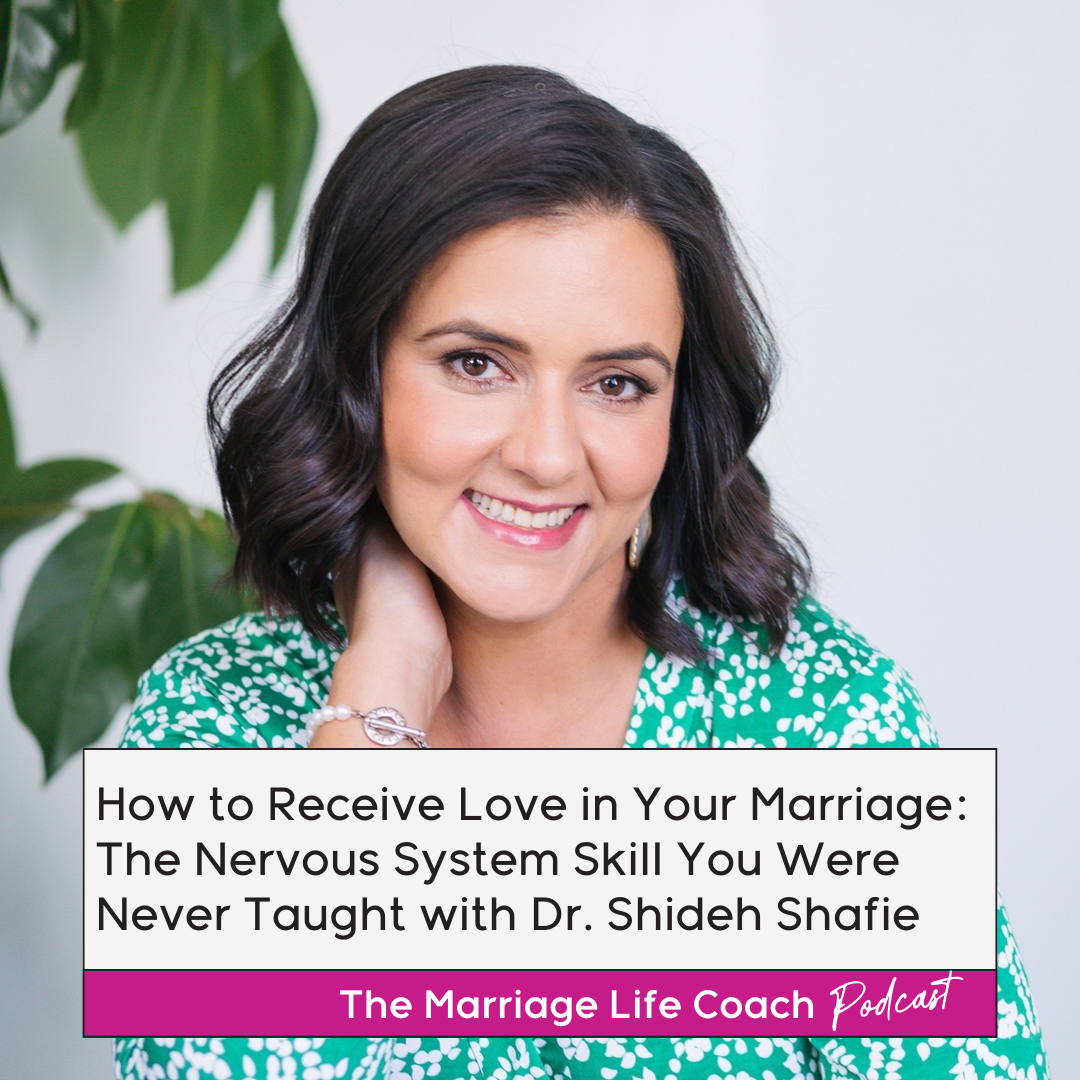
Today I am so excited because we are going to talk about something that might sound really simple, but is actually one of the most revolutionary and impactful acts you can practice in your marriage and your life.
Receiving.
Not just accepting or tolerating, but actually receiving love, help, pleasure, appreciation, support—all those kinds of things that we long for. How do we actually receive them?
This is something that I’ve noticed in my work with women who are smart and strategic and deeply committed to their marriages. We’ve been culturally trained, we’ve been socialized to give, to over-give, to anticipate everyone else’s needs before our own.
We run our lives as if they were five-star hotels—anticipating everyone’s needs, reading the room, adjusting constantly. The thing is that in a 5-star hotel there’s reciprocity. But at home? Our relationships often become deeply uneven—5-star effort for motel reciprocity.
But to have truly equitable relationships and reciprocity, we must learn to stop over giving and deeply receive. Because then we often find ourselves craving connection, but not feeling fully equipped to let it in—to actually receive the thing that we’re craving.
As I was preparing for this episode and thinking about what I wanted to talk about, I thought about: What if the marriage you want is actually the marriage you’re allowing yourself to receive?
Like what if it’s both that simple and that complex at the same time?
Why Receiving Is Actually a Nervous System Skill
I invited Dr. Shideh Shafie onto the podcast to talk about this. She is a board certified emergency physician and a high performance coach. She helps leaders live and lead without breaking. She blends neuroscience, conscious leadership, and behavioral psychology.
And the first thing I asked her was: What happens in our nervous system when we try to receive?
Shideh explained that receiving is actually just an uncomfortable experience. It’s a new experience often. It’s not a positioning that we’re often in. And so we often feel uncomfortable about it.
She shared a workshop she did with physician coaches where they had one person stand in the center and two people flank them. And they just said kind things that they noticed about them.
Some people were so uncomfortable receiving verbal compliments that they had to put their hand up if that was too uncomfortable and just have loving gaze placed on them instead.
People realized how uncomfortable that position was—to receive. For some people, it actually dysregulates them because they’re not used to it.
Physicians are really good at giving. Physician women who are often also mothers are very good at caregiving. A lot of women were socialized to give. What could I do to ease someone’s pain? What could I do to help them?
Giving can often be really easy for us, but receiving feels a little uncomfortable.
It’s Like Going to the Gym for the First Time
Shideh gave this analogy: If you go to the gym and it’s the first day you’ve ever gone to the gym, maybe you can lift a five pound weight overhead. But if you try to lift a 25 pound weight overhead, it’ll be uncomfortable for you because you are not practiced at it.
The discomfort in receiving is just—it’s something totally new. And your brain is asking: Is this safe?
The reason we have our brain is to keep us safe. And evolutionarily, it makes more sense for us to be busy out there getting and giving rather than receiving. There wasn’t a lot of space to receive evolutionarily.
So it’s not a natural function of the brain. It just takes a little bit of practice.
The “Deflect and Diminish” Pattern
Shideh talked about something she calls the “deflect and diminish” pattern.
This is the first thing people do anytime they’re not trained in receiving. They’re not actively working to train it out.
You know this one: Someone tells you “You look beautiful today” and you immediately say “Oh my God, you’re so gorgeous!” Ping-ponging it back. Or you say “This dress? I got it on sale!”
Either diminishing it or immediately deflecting it back.
I shared how I trained myself to interrupt this pattern, inspired by Louise Hay’s book “You Can Heal Your Life.”
Louise Hay said something to the effect of: People will deflect automatically. People want to receive more money, but they can’t even receive a compliment. And then they want to receive ginormous amounts of money or a promotion or the dream vacation.
She said: Start with compliments.
So I did. And I noticed how much I would automatically deflect or diminish.
I trained myself to say either “Thank you” or “Thank you, I receive that” to tell my brain I’m receiving it.
Online, if somebody says something kind, I’ll type “I receive that with a grateful heart.”
It’s been fascinating over the years—different people have commented that they’ve seen me do this hundreds or thousands of times at this point. And they’re like, “Maggie, now I’m doing it. I’m just saying thank you, I receive that.”
It’s the tiniest shift, but it’s creating safety in your body by receiving the little things to receive the bigger things.
The Simple Practice That Changes Everything
Shideh said: Put your hand on your chest and say “I receive that.” Or just “Thank you.”
Thank you is a beautiful acceptance.
If “I receive that” feels too woo-hippie for you (Shideh is okay being a woo-hippie master), just say thank you. And that really increases your capacity to receive.
Becoming Conscious of What You Actually Want to Receive
Here’s something Shideh said that really struck me:
When you can receive really well, you also start becoming conscious of what you actually want to be receiving. You’re not just receiving whatever gets thrown at you.
You start realizing what actually fills you up. It helps you open your heart to desire, to what it is you want in life.
And what’s really fascinating—there’s a lot of marketing about what you should want to receive. Especially to women.
A lot of people will think: To feel good, an act of wellness would be receiving a trip to the Caribbean or buying those red light masks for your face.
Shideh doesn’t even know if that’s something she should receive or not. She’s not interested in that. And she’s not saying it’s wrong for anybody else.
But maybe for you, receiving looks like: After you drop off your kids at school, coming home and having a cup of tea by yourself. Or stopping at the grocery store and getting a few things you want to eat that day and preparing something nice for yourself.
It’s inexpensive. It takes a little bit of time. A cup of tea takes very little time.
But when you’re receiving that, you realize: I actually don’t need to create all this energy to create things that are worth receiving. I just become really conscious.
You Also Get to Choose What You Don’t Receive
Shideh made another important point: When you’re conscious of receiving, you also get to decide what you don’t receive.
If someone gives you a compliment, you can receive it and say thank you.
But if someone says something critical that’s not useful to you, you don’t have to receive that.
Shideh comes from academic medicine—Ivy League academic medicine where they are in it to criticize and analyze.
You get to decide what part of it you receive and what you don’t. Because when you’re conscious of that, you have choice.
Receiving From Yourself First
One of the things Shideh and I talked about is receiving from yourself.
She shared how she has a very nice life. And one of the things she spends time thinking about is: Why? What have I done here that makes it look like this? To really understand that.
And that’s receiving from yourself. Receiving: What have I taken off my plate? What have I shifted that has allowed for this? And to take ownership of that.
Because as much as we take up the ownership of the bad things in our lives, we actually also need to be aware of the ownership of the good things in our lives so that they can continue.
Shideh is very diligent about going to the gym, getting enough protein, getting enough sleep. She has no sleep debt on her ring. But there’s a system she built. There’s a system she built in her life.
And it’s good for her to know what that is because sometimes people are struggling with that in coaching and she can share from her insights.
But it’s also helpful for her. The places in your life you’re winning—it’s really useful to understand why. Because that’s what we can teach other people too.
I do the same with my marriage. I’m a very happily married person in a world filled with unhappily married people. So I really have had to over years try to digest: What is it about us?
It’s not that we don’t have stressors. It’s not that bad things don’t happen. We have all kinds of wacky things happen all the time, just like everybody else.
One of my favorite discoveries from that: We laugh about things other people argue about. We just get to laughing faster.
You know how you’re like “This will be a funny story someday”? We start laughing in the moment. We’re like “Oh my God, this is such a funny story. I can’t believe you just put away everything I just took out in the kitchen.”
So receiving from yourself first—studying yourself first—is so important.
Your Partner Can’t Play Every Role in the Movie of Your Life
One of my favorite parts of this conversation was when we talked about the unrealistic expectations we put on our partners.
Our partners cannot play every role in the movie of our life.
I love to cast the Rock in examples because the Rock is always fun. Imagine that we’re in a movie and the Rock just plays every role.
The Rock is really great at doing some things the Rock is really good at. But Shakespeare may not be his forte. He may not be the best one to do a soliloquy.
He’s still the Rock. He’s still amazing. He’s still all these things.
But imagine if he was both the romantic hero and the romantic heroine and the funny best friend and the villain. At some point, we need some other names and faces in these roles.
In our marriages, we so often just want to cast our partner in every single role. And it’s so much pressure for us to expect that from them and so much pressure for them to try to be all these things—some of which they’re terrible at.
Shideh shared how her husband is not romantic. Not at all romantic, no rom-com. He’s also not handy.
So she knows Santa, the guy at the gas station that she goes to. She’s a serial “go to the same place” person. And she knows every service provider that she uses, including the gas station guy.
She called him: “Can you fix my tires? Because I really hate putting air in my tires. And my husband has been really busy, he hasn’t had time to do it. Can you just do it for me?”
And he was like “Yeah, sure.”
She told her husband: “Guess what, you never have to put air in my tires again.”
It’s something she doesn’t want to do. She gets to figure out where someone fills her needs.
She gave another example: A lot of male leaders need a space to talk about the challenges of their leadership. They can’t often talk to their peers—some of these guys are CEOs of companies, they’re not going to talk to competitors. They don’t necessarily have anyone to talk to.
But as a coach, she holds that space for them.
Also, their wives often can’t give it to them either. Not because there’s something wrong with the wife, but because she’s busy running the rest of their lives. She’s schlepping the kids to soccer and this and that.
She doesn’t want to hear about the challenge in the boardroom. She’s like “I’m tired. I can’t hear about your emotions around the boardroom while I’m busy schlepping your kids.”
So we do need spaces where we can go to different people for different things. And there’s nothing wrong with that. Just understanding that.
Because otherwise they get lonely and it creates a lot of tension.
Our partners can’t give us all the things and that’s okay. And we can be disappointed that they can’t fill all those roles, but they also are often doing other things. All of it’s okay.
The Difference Between Disappointment and Something Being Wrong
When I think about holding space—listening with compassion, listening without centering myself, centering the other person—sometimes your partner doesn’t have the capacity, the energetic bandwidth, the desire for whatever reason to be the person that holds that space.
We still need that space held. We still need to get it somewhere, somehow. Whether it’s colleagues, coaches, friends, whatever ways we do it.
And that doesn’t mean that your marriage is doomed.
A lot of people come to me like “Oh my God, is your marriage doomed?” I’m like no. It just takes more than one person to fulfill all the emotional needs in your life and in your partner’s life. And that’s okay.
Recognizing that nothing’s wrong when we notice these things is so important.
Grief Is the Natural Progression of Love
We talked about how we judge emotions. And I always say: Grief is proof of love.
If I’m sad I lost something—whether it’s a pen or a person—I loved it at some point and I don’t have it and then I miss it. It’s just proof that I was able to love and have joy and have delight in the presence of that thing or that person.
And now I’m sad that I won’t have that same thing. But nothing has gone wrong because that happened.
Shideh said: “It’s the natural progression of love. I love being a parent, but my kids are going to grow up and leave. I’ll still be a parent, but not in the same capacity.”
Every season of our life, there are seasons that end and cycles that end and experiences or jobs or you move home.
Even my example of when I got married—there are things that end for great reasons that you love, but it still means letting go of something that you will no longer have even if the thing you’re doing is something you really, really want.
The Practice of Receiving
Shideh’s final thought was this: Practice receiving and being in that green of gratitude of “Thank you so much.”
It really opens so many other energetic doors. When people are practicing that receiving and they’re like “thank you,” there’s a simple movement into gratitude which really does shift people in a very big way.
So here’s your practice:
Start with compliments. When someone says something kind, instead of deflecting or diminishing, just say “Thank you” or “Thank you, I receive that.”
Notice what you actually want to receive. Not what marketing tells you to want, but what actually fills you up.
Receive from yourself first. Study where you’re winning in your life and understand why.
And remember: Your partner can’t play every role in the movie of your life. And that’s okay.
What if the marriage you want is actually the marriage you’re allowing yourself to receive?
Connect with Dr. Shideh Shafie
Dr. Shideh Shafie is a board certified emergency physician and a high performance coach. She helps leaders live and lead without breaking.
Follow her on Instagram: @shideh.shafie
Follow her on LinkedIn: Shideh Shafie
Visit her website: www.shidehshafie.com
Join the Growth Gap Workshop (FREE)
If you’re navigating any kind of relationship challenge and want support, I invite you to join my free Growth Gap Workshop. I teach you how to bridge the gap when you and your husband are growing at different speeds—and these principles apply to all aspects of your relationship.
Get access to the workshop for free here
Work With Me Privately
If you’re a woman in a marriage that’s safe but stuck, mostly good but not nourishing, private coaching might be perfect for you. I work with women who have already decided to stay and want to close the gap between where their marriage is and where they know it can be.
Learn more about private coaching here.
About Maggie Reyes
Maggie Reyes is a Master Certified Life Coach and feminist marriage coach for high-achieving women who want to strengthen marriages that feel stuck but not broken. She is the host of The Marriage Life Coach Podcast, ranked in the top 2% globally, where she teaches high-achieving women the practical relationship skills they were never taught in school.
Through individual marriage coaching for women, Maggie helps clients improve communication, reconnect emotionally, and create real change in their relationships — even if their partner isn’t interested in couples therapy or coaching. She is the author of the bestselling Questions for Couples Journal and creator of the Soul-Centered Communication framework.
Maggie’s work is rooted in feminist values. While she primarily works with women married to men — navigating the patriarchal programming (and deprogramming) that shapes those relationships — she has also supported women in same-sex marriages. The same kinds of communication patterns, emotional disconnection, conflict loops, and repair skills apply regardless of gender. Her work is inclusive of diverse identities and experiences.
Marriage coaching for women who want to feel connected, not just committed
If you love your husband but feel disconnected, stuck in the same arguments, or exhausted from carrying the emotional load of the relationship, you’re not alone — and your side of the table is where your power lives.
Maggie specializes in individual marriage coaching for high-achieving women who want to feel loved, respected, and deeply connected again. Whether you’re looking for communication tools, emotional clarity, or a new way forward in your marriage, you’ll find support here.
✨ Transparency Note
This blog post was inspired by The Marriage Life Coach Podcast episode, prepared by my team and helped by AI. IT REALLY TAKES A VILLAGE PEOPLE ;-).
Thank you for reading, it’s an honor to be part of your day.