
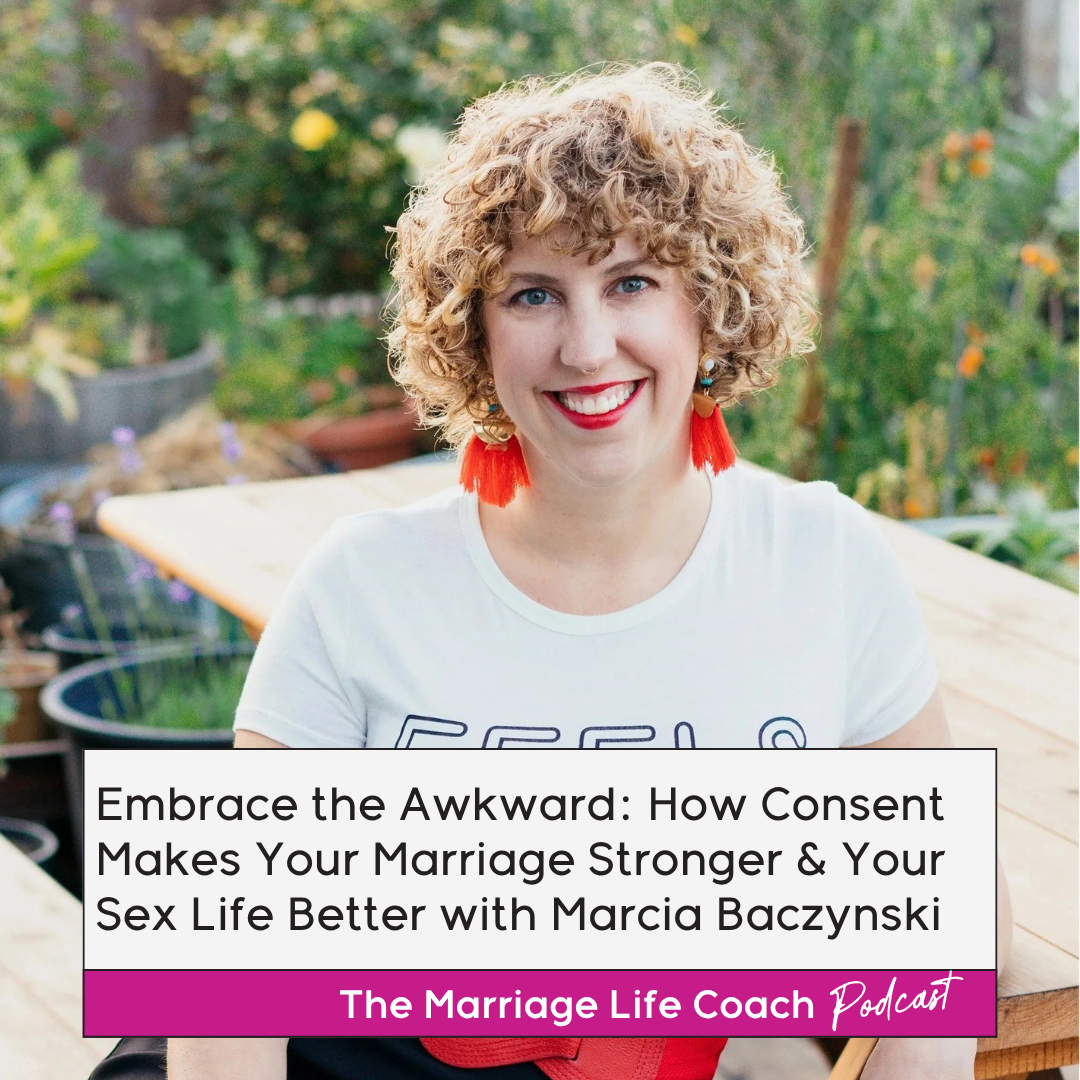
Ep 211 – How Consent Makes Your Marriage Stronger and Your Sex Life Better: A Conversation with Marcia Baczynski
A quick note: We talk about sex and sexual situations in this episode. If you need privacy to read this, come back when you have it.
I am so excited to share this conversation with you.
Today I’m talking with Marcia Baczynski about a topic I think we are under-educated on as a society—and that we need to have a better understanding of in order to thrive.
That topic is consent.
I absolutely promise you this is going to be fun, interesting, and useful.
What Is Consent?
When Marcia started doing this work 20 years ago, she didn’t realize she was becoming a consent educator. She thought she was just talking about sex and cuddling and intimacy.
But eventually she realized there’s this whole other thing we’re talking about.
A lot of times people are like: “Well, I don’t want to talk about consent. That’s just permission. And permission is scary or boring or brings up feelings of higher and lower, trying to get something from somebody.”
But the way Marcia thinks about it is this: What is the agreement we have for playing or sharing space together or interacting?
That’s already a shift in how we think about it.
We mostly move through the world making assumptions and guessing and hoping for the best.
But the clarity that can arrive in all of our relationships when we start making more clear agreements about all kinds of things—airport pickups, what we want for dinner, who’s going to put the kids to bed, what we’re going to do in bed once we put the kids to bed—is incredible.
Permission vs. Agreement
Here’s the distinction that landed for me:
Permission is something you give once. Like, you have permission to park on my lawn. It’s static. And even that is so debatable but for our purposes today let’s play pretend. 😉
Because we can absolutely revoke permission at any time but in our conversation on the podcast you will hear us say that permission is something I give to you or you give to me, one of us is gatekeeping. And giving something to someone else. Which we can also take away, withhold, use as a power over someone or feel disempowered asking for it.
AGREEMENTS are where it’s at, because in agreements we are two equals coming to negotiate something together.
In agreements there is no power over or under there is collaboration an negotiation and equality.
My sweet tender feminist heart LOVES agreements!
Marcia says: “Saying yes to something is not signing a contract. And saying no to something doesn’t mean you’re saying no forever. And being told no doesn’t mean it’s a no forever.”
It might mean a no for today. It might mean a no under these circumstances. It might mean no with you right now or until something changes.
If the relating is ongoing, then the agreements are ongoing.
The Gatekeeper Model vs. The Agreement Model
Most of us were raised in what Marcia calls the “gatekeeper model.”
In the gatekeeper model, one person (usually the woman) is the gatekeeper. She says yes or no. She’s not supposed to have desires or initiate. She just responds.
And if she says yes too much, she’s “too much.” If she says no too much, she’s “frigid.”
The other person (usually the man) is the initiator. He’s supposed to want sex all the time in a very specific way. He’s not supposed to have boundaries or limits. And if he doesn’t want sex, something must be wrong.
This model is dehumanizing for everyone.
As Marcia explains: “It’s incredibly dehumanizing to simplify everything to these tropes. What we want in sex is sexual expression and freedom and play and creativity. And we want to touch those parts of ourselves that are tender and vulnerable. If we have to fit into these tiny little boxes, it makes it really bland and it makes it not fun.”
The agreement model is different.
In the agreement model, both people get to have desires. Both people get to have limits. Both people get to put those on the table and say: What do we want to do tonight? What do we want to try?
It’s not about one person guarding the gate while the other person tries to get through.
It’s about two people creating something together.
Why Consent Is the Sexiest Thing Ever
Listening to Marcia talk about the agreement model, what came up for me is this:
The agreement model is an agency model. It’s a freedom model. It’s a self-expression model.
If we think about Maslow’s hierarchy of needs, the maximum thing for a human is full self-expression. Your basic needs are met—you have shelter, you have food. And then it’s: Can I be fully myself?
That, to me, makes consent the sexiest thing I’ve ever heard.
Because you get to be fully yourself. Your partner gets to be fully themselves. And you get to love the fully expressed version of each other—which is much deeper and richer and more nuanced and way more fun.
The Myth That They Should “Just Know”
One myth that comes up a lot: “We’ve been together 20 years. They’re supposed to know what I like. And if they don’t know, they don’t love me enough or they don’t care.”
But here’s the thing: What you liked might have changed in 20 years. What they liked might have changed.
Your bodies change. Your desires change. Your experiences change. Your physiological and emotional landscape changes.
Instead of assuming they should just know—you get to communicate it. You get to make new agreements. You get to keep evolving together.
Embrace the Awkward
One of Marcia’s principles is “embrace the awkward.”
Because yes, these conversations can feel uncomfortable at first. They can feel vulnerable. They can feel risky.
But that vulnerability is where the intimacy lives.
If we’re still operating in the gatekeeper model—even unconsciously—and our partner tells us something they want, we assume our only job is to say yes or no. And that shuts everything down.
But in the agreement model, there’s room for: Tell me more about what’s hot for you about that. Do we want to set some limits around that? Do we want to try this or do this?
It opens up conversation. It opens up intimacy. It opens up connection.
Consent Beyond the Bedroom
And here’s what’s beautiful: These principles work beyond the bedroom.
They work in friendships. They work in family dynamics. They work in everyday life.
Making clear agreements about what you want for dinner. Asking “What do you mean by that?” instead of assuming. Communicating your limits. Honoring someone else’s limits.
All of it creates more clarity, more connection, more freedom.
Listen to the Episode
This conversation will shift how you think about consent—not just in the bedroom, but in every area of your relationship.
Connect with Marcia Baczynski
Marcia Baczynski is a sought-after coach, writer, and presenter helping people reclaim desire, agency, and self-trust—especially in sex, relationships, and community. Her work sits at the intersection of embodiment, consent culture, and unlearning the “good girl” conditioning that keeps so many people disconnected from their own aliveness.
She is the co-author of Creating Consent Culture: A Handbook for Educators, a practical and widely used resource for teaching consent with nuance, care, and integrity. Marcia teaches internationally and has served as faculty with the School of Consent, Shakti Shiva Academy, and Esalen Institute.
Known for her warm, playful, and deeply ethical approach, Marcia blends clarity with compassion, inviting people to slow down, listen to their bodies, and make choices rooted in desire rather than obligation.
Join the Growth Gap Workshop (FREE)
If you’re navigating any kind of relationship challenge and want support, I invite you to join my free Growth Gap Workshop. I teach you how to bridge the gap when you and your husband are growing at different speeds—and these principles apply to all aspects of your relationship.
Get access to the workshop for free here
Work With Me Privately
If you’re a woman in a marriage that’s safe but stuck, mostly good but not nourishing, private coaching might be perfect for you. I work with women who have already decided to stay and want to close the gap between where their marriage is and where they know it can be.
Learn more about private coaching here.
About Maggie Reyes
Maggie Reyes is a Master Certified Life Coach and feminist marriage coach for high-achieving women who want to strengthen marriages that feel stuck but not broken. She is the host of The Marriage Life Coach Podcast, ranked in the top 2% globally, where she teaches high-achieving women the practical relationship skills they were never taught in school.
Through individual marriage coaching for women, Maggie helps clients improve communication, reconnect emotionally, and create real change in their relationships — even if their partner isn’t interested in couples therapy or coaching. She is the author of the bestselling Questions for Couples Journal and creator of the Soul-Centered Communication framework.
Maggie’s work is rooted in feminist values. While she primarily works with women married to men — navigating the patriarchal programming (and deprogramming) that shapes those relationships — she has also supported women in same-sex marriages. The same kinds of communication patterns, emotional disconnection, conflict loops, and repair skills apply regardless of gender. Her work is inclusive of diverse identities and experiences.
Marriage coaching for women who want to feel connected, not just committed
If you love your husband but feel disconnected, stuck in the same arguments, or exhausted from carrying the emotional load of the relationship, you’re not alone — and your side of the table is where your power lives.
Maggie specializes in individual marriage coaching for high-achieving women who want to feel loved, respected, and deeply connected again. Whether you’re looking for communication tools, emotional clarity, or a new way forward in your marriage, you’ll find support here.
✨ Transparency Note
This blog post was inspired by The Marriage Life Coach Podcast episode, prepared by my team and helped by AI. IT REALLY TAKES A VILLAGE PEOPLE ;-).
Thank you for reading, it’s an honor to be part of your day.