
Ep 212 – Depression, Medication, and Why Trying to Do It All Alone Is Not It
Today I’m sharing something a little different.
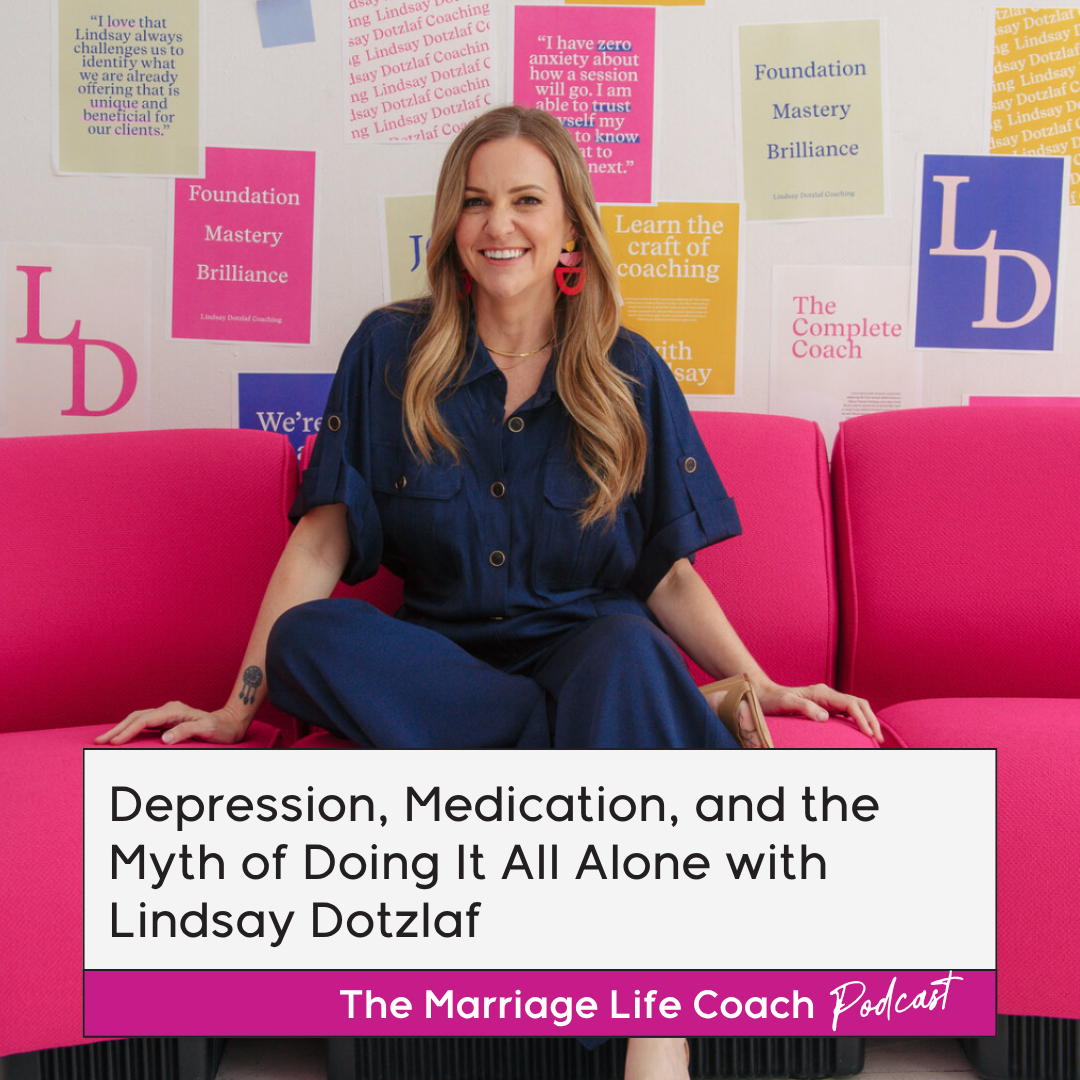
This is a conversation I had with my dear friend, Lindsay Dotzlaf, on her podcast Mastering Coaching Skills. When she asked me to come on her show and talk about coaches and mental health—specifically sharing about my mental health journey—I said yes immediately.
Why I’m Sharing This
Here’s the thing: We talk a lot on this podcast about doing the inner work. About taking responsibility for your half of the relationship. About choosing who you want to be and what values you want to express.
And I 100% believe in everything I teach. I use my own tools on myself on a regular basis.
And I also believe that sometimes the inner work is something we can do individually and sometimes the inner work requires us to get support.
That’s why I’m a coach—because I love supporting all of you, whether it’s through the podcast or in the different programs that I run. I’m a big believer in receiving support, asking for support, getting support.
And in this season of my life, when I am getting a lot of support, I wanted to share what it was like and what I was going through.
How It Started: Therapy and a Psychiatric Nurse
I had some really intense family situations and I started therapy.
I Googled “feminist therapist Florida” because I really needed somebody who was aligned with my values. And I am so grateful I found my therapist—she had that in her headline. And then as we started working together, she told me her major before she did therapy was women’s studies.
So here’s a tip: Look for people who meet your values. Whether you’re looking for a coach or a therapist, look for people that align with what matters to you.
My therapist—this brilliant woman that I love—suggested that I see a psychiatric nurse that she trusts and has worked with before. She said: “Let’s rule out anything physiological. Let’s just check what’s going on.”
And the conclusion was really interesting: I had depression. And I also have a lot of symptoms of ADHD.
By the way, if you are in FLORIDA and looking for a great Feminist Therapist, my therapist is Rebecca Lima and this is her website – https://www.rebeccalima.com/.
Starting Medication
When we talked about medicine, one thing I loved that the psychiatric nurse said was: “Let’s just try this and see if it helps.”
I started on a medicine called Wellbutrin, which helps both with depressive symptoms and with ADHD symptoms. And it was really life-changing.
Now, I want to say: Not every medicine is right for every person. And that is true, and that is real, and that’s okay.
I take high blood pressure medication as well, and it took us several tries to find the right one. Same thing here. And that’s okay.
If you’re hesitant and somebody that you love is recommending you see a psychiatric support person or try medication—please just try it. See if it helps.
We wouldn’t say “No, no, no, my leg is going to heal. It’ll be fine” without a cast. But we do that with mental health. So please—be open to trying what might help.
The Myth of “I Should Have This Figured Out By Now”
Sometimes I hear coaches say things like: “I’m a coach, so I shouldn’t need help” or “I should have figured this out by now.”
I’ve seen this a lot, and I just want to say: That is a function of this hierarchical society that we live in.
“I should be better than needing help” implies that needing help is somehow worse—as opposed to we’re all humans, interdependent, living in a society where we need each other.
I have pizza from Chicago in my refrigerator. I have grapes from Chile. I have apples from Mexico. We need each other to survive—for real.
And then when we have emotional needs or psychological needs or relational needs, all of a sudden we’re like “I should be able to do this by myself.”
There is such a thing as toxic hyper-individualism. Trying to do it all by yourself is absolutely not it.
Reconciling My Self-Concept with Depression
Here’s what was hard for me:
I got diagnosed with depression. And if you’ve ever met me or talked to me or heard me on the podcast, I am an enthusiastic person. I love people. I love life. I love coaching.
So to reconcile in my brain: “Wait, but that’s not who I am. That doesn’t match with how I think I am.”
That took me some time in therapy and self-coaching to really see that I could be this person who is enthusiastic AND be diagnosed with depression.
Depression isn’t everything. It isn’t all of me. It is just one thing in my life.
But when I looked at the symptoms of depression—difficulty starting things, difficulty being excited about things—I was like: “Oh, I definitely have all of those things.”
I know that it’s different. There are millions of people who have major depression where they feel only one flavor. They don’t feel the access to joy that I felt.
But even with access to joy, I still had depression. And it was impacting my life.
The Midnight Google Spiral
I got really scared. In the worst doom spiral I had, I was Googling: “Is depression a disability? Will I be able to work?”
And then I Googled: “Successful people with depression.”
Somehow I landed on John Hamm. Hi, John Hamm.
I found some article on Oprah Daily with all these famous people who have depression. And I was like: “Okay, I can still be me and have this thing.”
But I want to convey to you the level to which I was trying to reconcile this diagnosis with my life and how it would proceed.
I have spent years coaching people through their mental health journeys. I have referred people to therapy. I have normalized medication.
And still, when I was the person being diagnosed, I had to wrap my brain around it.
Permission to Take Care of Yourself
This episode is me being the kind of coach I want you to have. The kind of coach I want to be in the world.
Someone who models that asking for help is not a weakness. It’s wisdom.
Someone who shows you that sometimes support looks like starting therapy. Sometimes it looks like medication. Sometimes it looks like crying before and after a coaching call and then showing up for your client anyway and having it be one of your best calls ever.
Give yourself permission to do what you need to do to take care of yourself.
Listen to the Episode
This conversation will meet you where you are—whether you’re struggling right now, supporting someone who is, or just want to understand mental health better.
Connect with Lindsay Dotzlaf
Lindsay is such a thoughtful interviewer and I LOVED sharing my story so candidly on her podcast.
Lindsay Dotzlaf is the host of Mastering Coaching Skills, a podcast for coaches who want to be great at coaching. She’s also my dear friend and one of my favorite humans on the planet.
You can find more of her podcast and all her coaching programs here –
https://lindsaydotzlafcoaching.com/
Join the Growth Gap Workshop (FREE)
If you’re navigating any kind of relationship challenge and want support, I invite you to join my free Growth Gap Workshop. I teach you how to bridge the gap when you and your husband are growing at different speeds—and these principles apply to all aspects of your relationship.
Get access to the workshop for free here
Work With Me Privately
If you’re a woman in a marriage that’s safe but stuck, mostly good but not nourishing, private coaching might be perfect for you. I work with women who have already decided to stay and want to close the gap between where their marriage is and where they know it can be.
Learn more about private coaching here.
About Maggie Reyes
Maggie Reyes is a Master Certified Life Coach and feminist marriage coach for high-achieving women who want to strengthen marriages that feel stuck but not broken. She is the host of The Marriage Life Coach Podcast, ranked in the top 2% globally, where she teaches high-achieving women the practical relationship skills they were never taught in school.
Through individual marriage coaching for women, Maggie helps clients improve communication, reconnect emotionally, and create real change in their relationships — even if their partner isn’t interested in couples therapy or coaching. She is the author of the bestselling Questions for Couples Journal and creator of the Soul-Centered Communication framework.
Maggie’s work is rooted in feminist values. While she primarily works with women married to men — navigating the patriarchal programming (and deprogramming) that shapes those relationships — she has also supported women in same-sex marriages. The same kinds of communication patterns, emotional disconnection, conflict loops, and repair skills apply regardless of gender. Her work is inclusive of diverse identities and experiences.
Marriage coaching for women who want to feel connected, not just committed
If you love your husband but feel disconnected, stuck in the same arguments, or exhausted from carrying the emotional load of the relationship, you’re not alone — and your side of the table is where your power lives.
Maggie specializes in individual marriage coaching for high-achieving women who want to feel loved, respected, and deeply connected again. Whether you’re looking for communication tools, emotional clarity, or a new way forward in your marriage, you’ll find support here.
✨ Transparency Note
This blog post was inspired by The Marriage Life Coach Podcast episode, prepared by my team and helped by AI. IT REALLY TAKES A VILLAGE PEOPLE ;-).
Thank you for reading, it’s an honor to be part of your day.